Pomelo is fintech infrastructure for Latin America: banks and fintechs use it to issue cards and run account programs. I joined in 2021 as a senior designer on the partner dashboards and stayed almost four years, the last year and a half leading the UX team and still designing billing and automations myself.
This case is about billing. Pomelo charges every client for the cards it issues and the transactions it processes, each on its own contract, currency and tax rules. When I picked it up, all of that was done by hand. Someone in finance read each contract PDF and typed the numbers into a spreadsheet, for 77 clients in five countries, and only 22% of invoices went out on time.
Facturas
Consultá, descargá e informá los pagos de tus facturas
Febrero 2024
Factura #0025203-01ARS 975.23500
Emisión: 01/02/2024Vence hoy
Factura #0025204-01ARS 1.240.80050
Emisión: 01/02/2024Vence en 8 días
Factura #0025205-01ARS 318.42000
Emisión: 01/02/2024Vencimiento: 16/02/2024
Factura #0025206-01ARS 2.105.96075
Emisión: 01/02/2024Vencimiento: 16/02/2024
Importe a pagarARS 60.000,00
Te dejamos los datos para realizar la transferencia
BancoBanco Ejemplo
Número de cuenta000-000000/0
Concepto ABCARS 120.000,00
Concepto DEFARS 80.000,00
Concepto GHIARS 45.000,00
SubtotalARS 200.000,00
IVA 10,5 %ARS 21.000,00
TotalARS 221.000,00
Factura #0025203-01ARS 975.23500Pago informado
Se envió tu pago
The billing screens, redrawn in 2026 from the original screens, with placeholder data
Role
Senior product designer, then leading the UX team, five people and about seven at one point
When
2023 – 2024, within 2021 – 2025 at Pomelo
With
Product, engineering and finance
Scope
Billing for banks and fintechs across four tax regimes
The decision
Start with sending invoices from one place, and build toward entering each contract once and deriving everything from it
What changed
On-time invoices 22% → 95% · unpaid bills $6M → $3M · no external billing teams
Prices nobody could query, quantities nobody had yet
Prices lived in private contracts that no system could read. Quantities were supposed to come from a data lake that hadn’t been built yet. And invoices went out under four regimes: electronic invoicing in Argentina, NF-e in Brazil, CFDI in Mexico, and government pre-authorisation in Colombia. The tax side was for engineering and finance to build, and I wasn’t the one solving it.
Billing is price times quantity
Starting with the part we could build
The contracts were digital, but nothing stored what was in them in a form the data and engineering teams could use. No system had the price, so no system could multiply it by a quantity, and calculating invoices automatically was blocked until other teams digitised the contracts. Billing covered three products, Cards, Identity and digital accounts, and Cards was by far the most complex: eleven concepts, each of which could change by client, country, contract and card brand.
So we started with the one step every invoice has in common, which is sending it. At the time all of them went out by hand, one by one, four to seven for each client, each email carrying a detailed summary of that client’s operation. Nothing stopped an invoice for one client from going to another, and that had already happened once. Payments were followed by hand too, in one mega-file where the team marked who had paid what (its real name was Global Tracker). Nobody measured whether a client had received what we sent. Starting there also meant building the place where the contract details would live, such as which day to send and to which addresses, which the later calculation would need anyway. The first users were Pomelo’s own billing team, who were doing all of it by hand.
In the backoffice we drew one screen to upload an invoice and describe it, with its number, currency, period and the concepts it bills, and one to set, for each client, the day its invoices go out and the addresses they go to.
Configura cuándo y cómo se envían las facturas a este cliente
Envío de facturas
Día de envío de facturasTodos los viernes a las 18:00hs (GMT 0)
Dirección de contactofacturas@ejemplo.com, pagos@ejemplo.com, cto@ejemplo.com
Información Bancaria de Pomelo
Utilizaremos esta información para compartírsela al cliente
CBU0000000000000000000000
Aliasejemplo.alias.pago
Razón socialPomelo Ejemplo S.A.
Conceptos a Facturar
Card Printing
Logistics
MC Invoice
Processing & Bin Sponsorship
Liquidación
CASS
Visa Invoice
Identity
Accounts
Día de envío de facturas
Enviar el día
En el horario18:00GMT 0
Se guardaron los cambios
How a client’s invoices are sent, redrawn in 2026 from the original wireframe, with placeholder data and wording, and an added modal, Off state and confirmation
The contract as the source of truth
We decided to enter each contract once and derive everything else from it: invoices, reminders, balances. I split the work into two tracks that ran in parallel. A backoffice, where finance sets up a contract and the system generates the invoices, and a dashboard where partners see every invoice and pay it.
One contract, entered once
We drew the backoffice from the client down, since everything billed belongs to one: a client has its data, its contracts and the products it is billed for.
ARES
Clientes
Acá encontrarás todos los clientes y el estado de sus productos
Acá encontrarás toda la información del cliente, sus reglas de negocio, y las configuraciones de sus productos
E
Datos del cliente
Nombre del clienteEmpresa Ejemplo
ID del clientecid-12…abcde
EstadoActivo
Contratos
Adenda de precios
Configuración de productos
ProductoBranch IDEstado
Billing – Argentinabid-12…abcdeActivo
Billing – Brasilbid-12…fghijActivo
The client list and a client’s detail, redrawn in 2026 from the original wireframes, with placeholder data and wording, and an added search result, copy confirmation and menu
Under a client sit a price addendum and the contract itself. The addendum holds the prices and when each is billed, and the contract is one long form with a block for each price rule.
Aquí encontrarás la información contractual del cliente.
Información general
Client nameEmpresa Ejemplo
Client IDcli-000000000000
Branch NameEmpresa Ejemplo - ARG
Branch IDbra-000000000000
Fecha del contrato01-01-2024 al 31-12-2024
Vencimiento de Facturas15Días
Dirección de contactofacturacion@ejemplo.com, finanzas@ejemplo.com, contabilidad@ejemplo.com
Productos Contratados
Cards
Digital Accounts
Identity
Processing & Bin Sponsorship | Cards
Free Revenue Sharing
Tipo de DatoNo aplica para la facturación
Valor fijo de tipo de porcentaje
No aplica para la facturación
Cargo Mínimo
Tipo de DatoValor fijo de tipo de porcentaje
Valor fijo de tipo de porcentaje
No aplica para la facturación
Sobre qué aplicaPorcentaje de Rev. Sharing
Porcentaje de Rev. Sharing
Trx. Aprobadas
Porcentaje10%
Revenue Sharing (Fijo)
Tipo de DatoValor fijo de tipo de porcentaje
Valor fijo de tipo de porcentaje
No aplica para la facturación
Sobre qué aplicaTrx. Aprobadas
Porcentaje de Rev. Sharing
Trx. Aprobadas
DivisaUSD
USD
ARS
Monto10$
Revenue Sharing (Adicional)
Tipo de DatoValor fijo de tipo de porcentaje
Valor fijo de tipo de porcentaje
No aplica para la facturación
Sobre qué aplica
Porcentaje de Rev. Sharing
Trx. Aprobadas
Porcentaje8%
Alta de Licencia
Tipo de DatoValor fijo de tipo de porcentaje
Valor fijo de tipo de porcentaje
No aplica para la facturación
Sobre qué aplica
Porcentaje de Rev. Sharing
Trx. Aprobadas
Porcentaje5%
Porcentaje del IC Procesamiento Emisor
Tipo de DatoValor fijo de tipo de porcentaje
Valor fijo de tipo de porcentaje
No aplica para la facturación
Sobre qué aplica
Porcentaje de Rev. Sharing
Trx. Aprobadas
Porcentaje15%
Monto del IC Procesamiento Emisor
Tipo de DatoValor fijo de tipo de porcentaje
Valor fijo de tipo de porcentaje
No aplica para la facturación
Sobre qué aplica
Porcentaje de Rev. Sharing
Trx. Aprobadas
Porcentaje20%
The contract entry, redrawn in 2026 from the original screen, with placeholder data and added lists
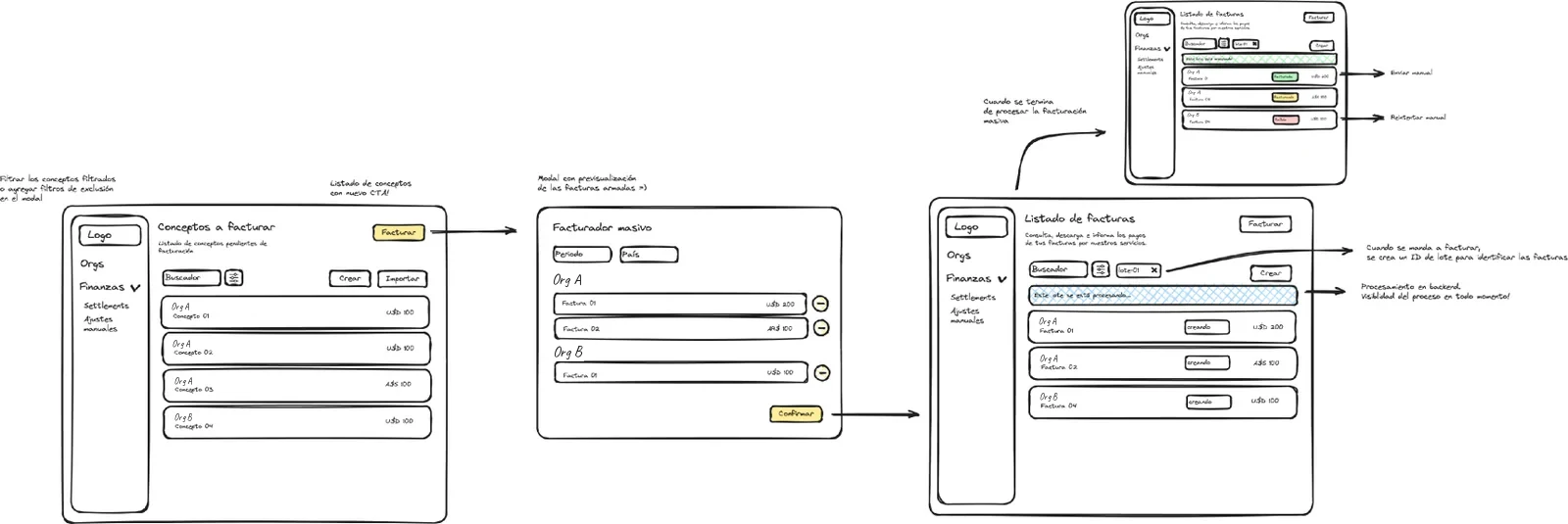
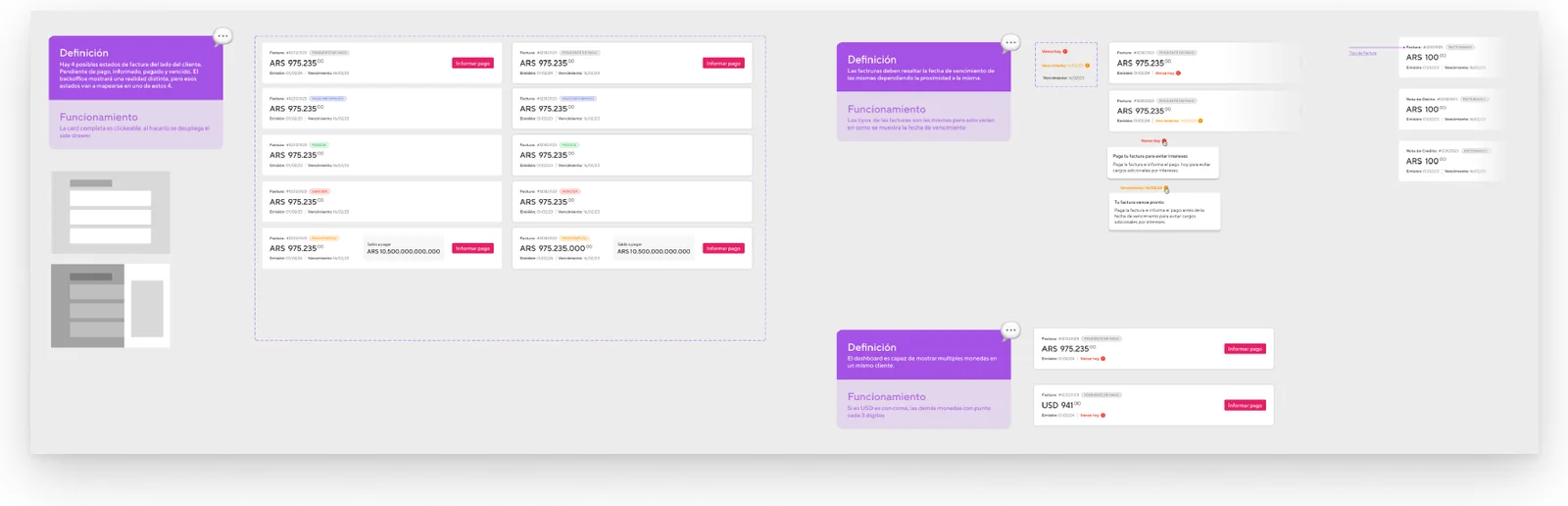
We wireframed together in Excalidraw with the whole team on a call. Before drawing any screens, I wrote down every state an invoice can be in: pending, reported, paid, overdue, partially paid, or reversed with a credit note. The partner dashboard is built around those states, so a partner can always tell where a bill stands without having to ask anyone.
Six states an invoice can be in, and what moves it between them
Early wireframes, drawn in Excalidraw with the team, client names covered
Every state an invoice can be in, written down before the screens
The partner dashboard that came out of them lists every invoice, with a drawer that shows the PDF and a pay action, and lets a partner report a payment with the bank details and, for Brazil, a PIX code.
ARES
Finanzas
Facturas
Consultá, descargá e informá los pagos de tus facturas
Buscar facturas
Febrero 2024
Factura #0025203-01ARS 975.23500
Emisión: 01/02/2024Vence hoy
Factura #0025204-01ARS 1.240.80050
Emisión: 01/02/2024Vence en 8 días
Factura #0025205-01ARS 318.42000
Emisión: 01/02/2024Vencimiento: 16/02/2024
Factura #0025206-01ARS 2.105.96075
Emisión: 01/02/2024Vencimiento: 23/02/2024
Factura #0025207-01ARS 642.30000
Emisión: 01/02/2024Vencimiento: 28/02/2024
The partner dashboard’s invoices, redrawn in 2026 from the original screen, with placeholder data
ARES
Finanzas
Facturas
Acá podrás encontrar todas tus facturas en un mismo lugar.
Saldo totalARS 38.250,00
Nro de FacturaTipo de FacturaEmisiónVencimientoMontoEstado
#00000617Impresión de TarjetasCards12/02/202419/02/2024ARS$ 17.850Pendiente de pago
Descargar FacturaDescargar Cálculo de DeudaCentro de ayudaInformar un problema
#00000598Envío de tarjetasCards05/02/202412/02/2024ARS$ 12.400Pago informado
#00000553Impresión de TarjetasCards22/01/202429/01/2024ARS$ 9.600Pagada
Cuotas del mes actualARS 33.650,00Bajaron un 12% respecto al mes pasado
Cuotas proyectadas para fin de mesARS 41.200,00Bajan un 8% respecto al mes pasado
Tipo de FacturaMonto Actual AcumuladoEstado
Envío de tarjetasCardsARS$ 3.450Se emite en 10 días
Impresión de TarjetasCardsARS$ 2.880Se emite en 10 días
Processing & Bin SponsorshipCardsARS$ 27.320Se emite en 10 días
Account Maintenance ServicesDigital AccountsARS$ 0,00Se emite en 10 días
Intereses Acumulados por MoraCardsARS$ 0,00Se emite en 10 días
LiquidaciónCardsARS$ 0,00Se emite en 10 días
Mastercard Invoice RebillingCardsARS$ 0,00Se emite en 10 días
¿Tenés una idea para una nueva funcionalidad?Dejá tu opinión
The invoices in two tabs, issued and still to issue, redrawn in 2026 from the original wireframe, with placeholder data, an added search and a day going by
We also drew the invoices with a second tab for the ones not yet issued, with what has accrued toward each and the days left before it goes out. Paying is a short form, and so is reporting a problem with an invoice, which opens with the invoice’s own data already on it.
Completá el formulario y nuestro equipo revisará tu solicitud
Nuevo Proceso de Reportes
Completá el formulario a continuación y nuestro equipo se encargará rápidamente de tu solicitud. Podés hacer un seguimiento de tus tickets en el listado de tickets de Jira.
Datos del reporte
Número de factura0025204-01
ConceptoImpresión de Tarjetas
ProductoCards
Fecha de emisión01/02/2024
Fecha de vencimiento09/02/2024
MontoARS 1.240.800,50
EstadoPendiente
Contanos cuál es el problema
El cálculo de deuda y el monto no coinciden o no parecen correctos
Tengo preguntas sobre el concepto facturado
Experimenté problemas con el pago
Consultas generales
Otros motivos
Describí brevemente el problema
Adjuntá un archivo si aplica
Arrastrá o seleccioná un archivo de tu dispositivocaptura.png84 kb · png
Se envió tu reporte
Reporting a problem with an invoice, redrawn in 2026 from the original wireframe, with placeholder data and wording, and an added attachment and confirmation
Behind the partner’s view is the backoffice, where finance works. When an invoice that has already gone out needs correcting, they raise a credit note against the original, line by line, and the invoice goes to the state the spec says it should.
ARES
Finanzas
Crear nota de crédito
Modifica los valores para crear el documento nuevo
A credit note in the backoffice, redrawn in 2026 from the original screen, with placeholder data and added reasons and confirmation
Six small things from the dashboard and the backoffice, close up and set moving, with placeholder data: where an invoice stands, a row’s actions, sending an idea, copying a number, which concepts are billed and a tour of the page.
Factura #0025203-01ARS 975.23500
Emisión: 01/02/2024Vence en 8 días
Where an invoice stands
Estado
Pendiente de pago
Descargar Factura
Descargar Cálculo de Deuda
Centro de ayuda
Informar un problema
Pendiente de pago
Pagada
A row’s actions
Compartí tu opinión
Contanos brevemente tu idea o dejanos un comentario
¿Qué tan importante sería para vos esta funcionalidad?
¿Cuál es tu dirección de email?
Se envió tu mensaje
An idea, sent
BancoBanco Ejemplo
Número de cuenta000-000000/0
A number, copied
Conceptos a Facturar
Card Printing
OnOff
Logistics
OnOff
MC Invoice
OnOff
Processing & Bin Sponsorship
OnOff
Liquidación
OnOff
CASS
OnOff
Visa Invoice
OnOff
Identity
OnOff
Accounts
OnOff
Concepts, on and off
Facturas
Saldo totalARS 84.500,00
Nro de FacturaEstado
#00000617Pendiente de pago
Explora tus Facturas
En esta sección, podrás acceder a un registro de todas las facturas relacionadas con tus transacciones en Pomelo. Mantén un registro organizado y fácil de consultar de tus documentos financieros.
Tus Facturas
Aquí tienes todas tus facturas: número, concepto, emisión, vencimiento, monto y estado. Todo a tu alcance.
Acciones Rápidas
Descarga facturas y cálculos de deuda, accede a documentación adicional si tienes preguntas, y reporta problemas fácilmente.
Gestiona tus Facturas
Paga tus facturas y revisa tu estado de cuenta. Aquí podrás encontrar los datos bancarios de Pomelo y realizar pagos de una o varias facturas de manera sencilla.
A tour, a step at a time
Three A/B tests, and what each moved
We ran three A/B tests along the way. A direct payment reminder got 20% more payments before the due date than one that explained the context. A PIX code on Brazilian invoices, which clients there had asked for so they could scan a QR and pay directly, made no difference in the test. We shipped it anyway, and as far as I know it stayed. PIX carries a lot of weight in Brazil today. And taking the amount out of the notification email raised platform DAU by 8%.
Three A/B tests, and what each one moved
That last one won, and I argued against it. It meant hiding the amount to get people into the platform. We tried several variants of that email, and I don’t remember which one stayed.
Matching payments was the bigger problem
Billing turned out to be a small part of something larger. It grew into collections, finance, reconciliation and payments, all built from nothing, and reconciling payments was the hardest of them. Pomelo had a banking licence, so we considered giving each client its own CBU to pay into. The limits on transfers to a CBU did not allow the amounts clients had to pay, so it was not an option. We threw away a lot of ideas like that one.
Leading the team while designing billing
Through this project I was also leading the UX team, and I had more or less started before the title said so. It was five people, about seven at one point. Leading it meant hiring, planning, estimating the workload and working out how many people it needed, while I kept designing billing and automations myself as a senior. A lot of that was above my pay grade at the time.
What I learned there is that culture and a healthy place to work are almost everything, and so is trusting the people on your team (I know it sounds like feng shui). We had a good time working together, and I still keep in touch with every one of them. I also think a design lead has to stay hands-on: one who can’t keep up with the tools, the systems and the problems the team works on, or decides not to, can’t lead it well.
What changed
Invoices delivered on time22%→95%More than four times as many, on time
Error rate per invoice6%→2%A third of the errors
External billing teams4→0None needed any more
Unpaid bills, USD6M→3MHalf as much owed
Looking back, the order is what I would keep: we started with the one step nobody else had to build first, sending the invoices, and the place we made for it, with each client’s send day and addresses, was built to hold what the calculation would need later. Collections, reconciliation and payments grew out of it, all from nothing.
Fintech-as-a-serviceBilling automationBackoffice + partner dashboardLed the UX team